SSTV Audio Challenge
Published
25/02/26
Read Time
1 min read
Author
Amir Aliu
Challenge Information
- Artifact:
output.flac - Duration: ~115 seconds
- Sample Rate: 48000 Hz
- Channels: Mono
Step 1 - Initial Inspection
The file was:
output.flac- about 115 seconds long.
My first thought was:
- Maybe spoken audio?
- Maybe morse?
- Maybe spectrogram art?
So I tried direct transcription:
from mutagen.flac import FLAC

f = FLAC("output.flac")
print("length", f.info.length)
print("sample_rate", f.info.sample_rate)
print("channels", f.info.channels)
print("tags", dict(f.tags) if f.tags else {})
It returned:
length 3.713832199546485
sample_rate 22050
channels 1
tags {}
Then I tried speech recognition:
import speech_recognition as sr

r = sr.Recognizer()

with sr.AudioFile("output.flac") as source:
    audio = r.record(source)

print(r.recognize_google(audio))
It returned:
TV 459 amazing soundTV seemed like a hint, but nothing practically useful yet.
Step 2 - Spectrogram Analysis
When audio doesn't make sense audibly, I always check the frequency domain.
Installed matplotlib:
python -m pip install matplotlibThen generated a spectrogram:
import matplotlib
matplotlib.use('Agg')
import matplotlib.pyplot as plt
import soundfile as sf

x, sr = sf.read('output.flac')
plt.figure(figsize=(18,6))
plt.specgram(x, NFFT=2048, Fs=sr, noverlap=1024, cmap='magma')
plt.ylim(900, 2500)
plt.tight_layout()
plt.savefig('spectrogram_900_2500.png', dpi=180)
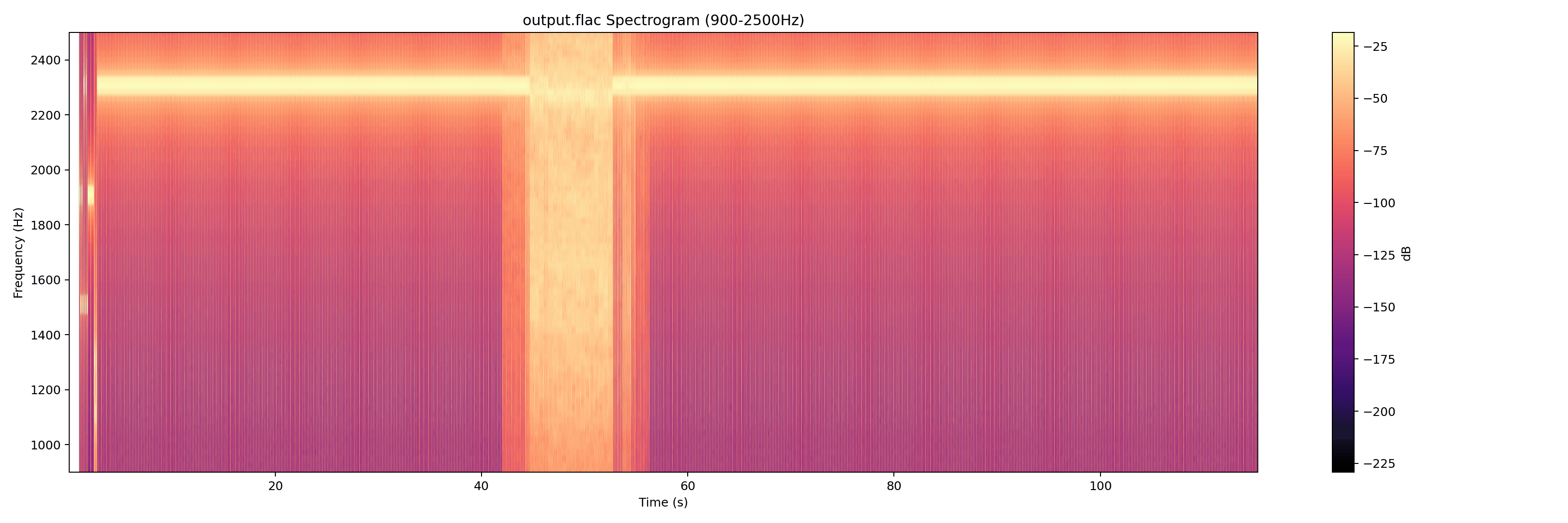
It generated this spectrogram:
The moment I saw the structured horizontal tone patterns between 900-2500 Hz, I thought:
- That looks like SSTV (Slow-scan television).
And once you see SSTV patterns, you can't unsee them.
Step 3 - SSTV Decoder
I installed an SSTV decoder:
python -m pip install git+https://github.com/colaclanth/sstv.gitTried CLI:
sstv -d output.flac -o decoded.pngBut Windows threw a terminal handle error. So instead of wasting time debugging the CLI, I switched to using the Python API directly.
Step 4 - Forcing Modes
Automatic VIS detection returned unsupported code 26. That meant either:
- Corrupted VIS
- Custom mode
- Or detection failure
So I brute-forced common SSTV modes:
from sstv.decode import SSTVDecoder
import sstv.decode as dec
from sstv import spec

dec.log_message = lambda *a, **k: None
dec.progress_bar = lambda *a, **k: None

modes = [
    ('M1', spec.M1), ('M2', spec.M2), ('S1', spec.S1),
    ('S2', spec.S2), ('SDX', spec.SDX), ('R36', spec.R36), ('R72', spec.R72)
]

for name, mode in modes:
    d = SSTVDecoder('output.flac')
    h = d._find_header()

    if h is None:
        print(name, 'no header')
        continue

    d.mode = mode
    vis_end = h + round(spec.VIS_BIT_SIZE * 9 * d._sample_rate)
    img_data = d._decode_image_data(vis_end)
    img = d._draw_image(img_data)
    out = f'decoded_forced_{name}.png'
    img.save(out)
    print(name, 'saved', out)
Mode M1 produced a clean readable image. That confirmed the hypothesis.
Final Flag
THJCC{sSTv-is_aMaZINg}25/05/26 | 1 min read
BSides Prishtina 2026 CTF Writeups
Crypto, forensics, misc, OSINT, pwn, reverse engineering, and web solves from BSides Prishtina 2026.
16/05/26 | 1 min read
TJCTF 2026 CTF Writeup
Challenge writeups from TJCTF 2026.
25/02/26 | 1 min read
THJCC 2026 CTF Writeup
Layered forensic and steganography solves from THJCC 2026.